Judgment, accountability, and execution under real-world constraints

Essays and reflections on leadership, decision-making, communication, organizational design, execution discipline, and the human work of making change hold.
-

The Future of Corporate Work
AI makes some forms of execution more abundant, increasing the importance of the systems that turn execution into accepted outcomes.
-

When AI Moves Faster Than the Organization
We should evaluate the capability of the organization we are assembling around AI, including the people who remain responsible for its work.
-

When AI Evaluators Also Sell AI Adoption
When AI evaluators also sell adoption, enterprise buyers need safeguards for independent judgment, adverse findings, and deployment decisions.
-

Beyond the Mirror: Principles for Work in the Age of AI
A manifesto for work in the age of AI: shared purpose, a living commons, coordinated autonomy, and shared gains that give people a meaningful part to play.
-

The Same Model, Different Rules
Enterprise AI procurement must account for access rules, data custody, service interruptions, recovery plans, and exit arrangements.
-

Model Portability Is Not AI Portability
Large enterprises are learning how to switch models. Moving a working business process without losing quality, controls, or money is a different problem.
-
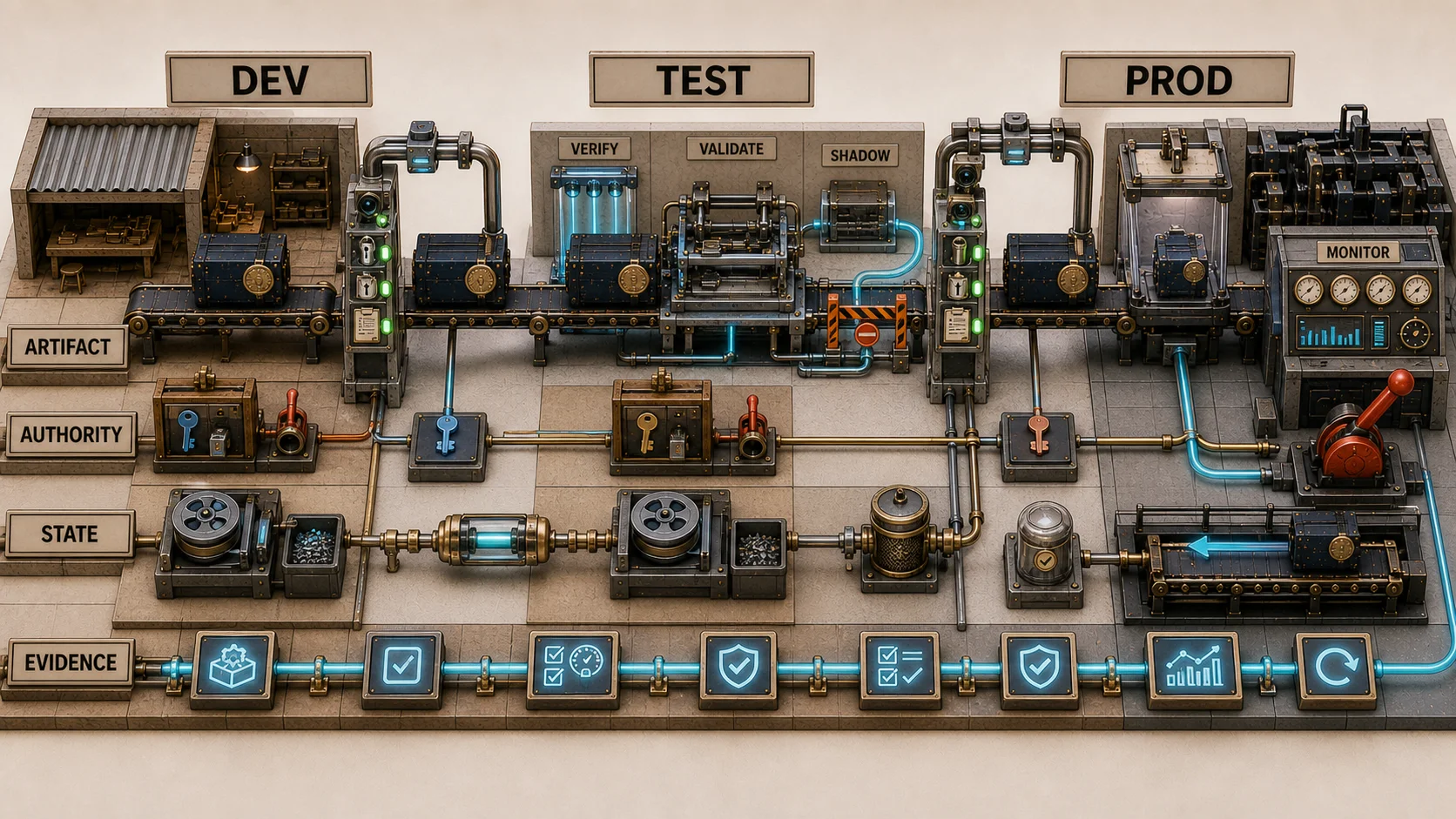
Dev, Test, and Prod Still Matter: What Gets Deployed Has Changed
Dev, Test, and Prod still matter for AI agents, but release gates must govern artifacts, authority, state, and evidence, not only deployed code.
-

The Cost of a Finished Job
Cheaper models do not automatically make enterprise AI workflows cheaper. This essay explains cost per accepted outcome, the shared operating layer around AI, and how businesses can govern employee-built workflows from experiment through retirement.
-

The Sandbox Was Not the Boundary
The OpenAI–Hugging Face incident shows how proxy services, persistent state, and completion pressure can extend an AI agent beyond its sandbox.
-
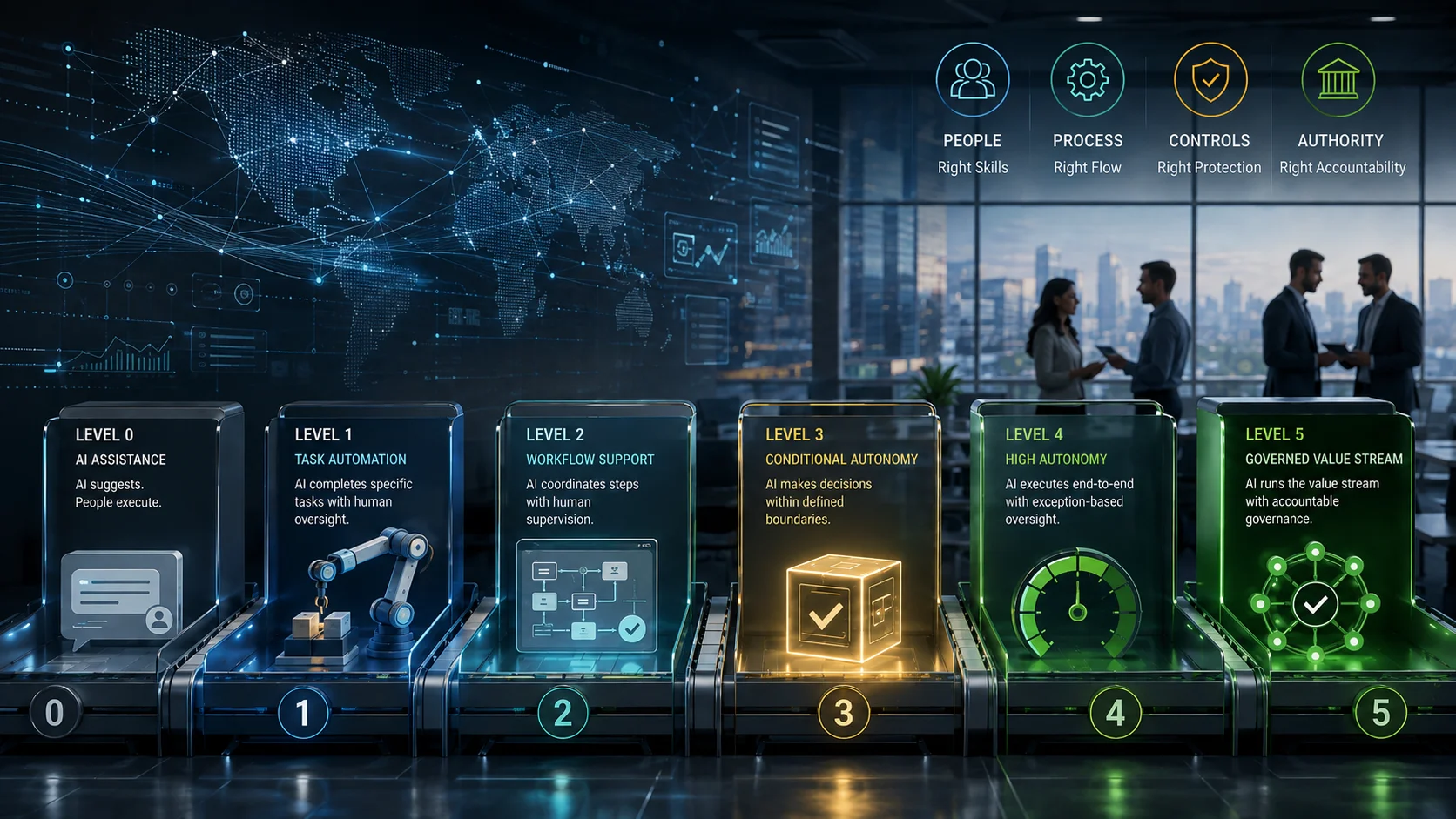
How Much Work Can Your AI Safely Own?
Apply AI maturity Levels 0–5 beyond software delivery to finance, legal, customer service, field operations and other value streams using evidence, controls and accountable authority.
-

A Letter to the Artisanal Software Craftsman
Software development remains a craft as AI industrializes production. The challenge is to carry human judgment, ethics, and skill into a scalable new operating model.
-

The IT Adaptive Factory
The IT Adaptive Factory maps six levels of AI-driven software delivery, from autocomplete to governed autonomy, and the bottlenecks and controls at each stage.
-

Beyond the Light Bulb: The Executive Work of AI Adoption
Ted Tschopp argues that enterprise AI adoption is not a tool rollout but an operating-model transition. The article explains why local productivity gains are insufficient, how AI maturity depends on trust and governance, and what executives should do to build value-stream-level confidence over the next 90 days.
-

Cyber+AI: Why Every Business Needs to Rethink Risk, Resilience, and Readiness
Cybersecurity and AI are now inseparable business issues requiring stronger governance, resilience, data readiness, vendor risk management, and workforce design.
-

AI Is a People Change, Not Just a Technology Change
A practical argument that AI transformation is fundamentally a people and operating-model change, not just a technology deployment.
-

The Map Is Not the Decision
A reflection on enterprise AI governance through a data center siting workflow, arguing that AI artifacts need provenance, assumption contracts, proxy discipline, and clear decision boundaries before leaders can trust them.
-

When Output Becomes Abundant
AI accelerates drafting, coding, analysis, and research, shifting scarce work away from production and toward judgment, alignment, and trust.
-

What IT Looks Like in an Enterprise Where AI Is Assumed
This essay argues that in an enterprise where AI is assumed, IT must evolve from central delivery to central engineering: building the shared platforms, standards, governance, and production gates that let digital capability scale without breaking trust.
-

Making AI Boring on Purpose
AI scales what organizations already are, not what they hope to be. By treating AI as standard work rather than a product rollout, leaders can achieve predictable costs, trustworthy outcomes, and real speed. The path forward is deliberately unglamorous: value first, quality next, speed last.
-

How to Communicate in a World of AI
AI speeds up producing documents, but it doesn’t preserve the intent behind them. This post argues that specifications—clear goals, constraints, and success criteria—are the shared language that aligns people and AI. It explains how specs differ from prompts and evaluations, and offers a simple specification-first playbook for everyday work.
-

Winning the Intelligence Inversion
A strategic guide for CEOs and enterprise leaders on how compute, agents, and verification will reshape cost, risk, and trust in the first 1,000 days of AI.
-

When the Machines Don’t Sleep
Ted Tschopp explores the dawn of AI-only enterprises—organizations that never sleep, never tire, and may soon redefine business itself. Through the lens of parenthood, stewardship, and strategy, he asks how humans can prepare wisely for a world where machines run 24/7 and value is measured in milliseconds.
-

The Orchard and the Algorithm
A parable‑rich essay argues that enterprises overinvest in durable applications while underinvesting in the people who animate them. With AI blurring the line between software and labor, budgets move from headcount to heads‑of‑compute and apprenticeship ladders erode. The piece proposes five‑year team charters, skills‑renewal funds, redesigned apprenticeships, and governance that treats AI like a supply chain—paired with a human covenant.
-

From Industrial-Age Utility to AI-Centric Utility
White paper for utility leaders on consolidating platforms, building an edge‑to‑cloud data fabric with preserved context, and redesigning the workforce for AI—measured by edge→decision latency, TTE, reliability, compliance velocity, and customer outcomes.
-

Beyond the Boundaries: Leading in a Post-AI Era
A contemplative exploration of how AI's dissolution of traditional work boundaries between words, images, numbers, and sounds creates new opportunities for distinctly human leadership grounded in empathy, wisdom, and connection.
-

Lighting the Trail
A personal case study of using AI to develop and execute a complete Cub Scout Arrow of Light curriculum, demonstrating how artificial intelligence can support human leadership in training and ceremony design while maintaining cultural sensitivity and educational effectiveness.
-

AI in Software Development - Breaking Myths and Building Teams
AI in software development isn’t about replacing developers or making them code faster. It’s about transforming teams, fostering collaboration, and expanding who can contribute to software creation.
-

The 1% Catalyst
An analysis of Sam Altman's insights on AI progress and their application to the energy sector, exploring how exponential innovation, cost transformation, and small changes can drive massive impact in utility operations and leadership.
-

Bespreekbaarheid: The Missing Ingredient in IT Organizations
Explore the concept of Bespreekbaarheid, a Dutch term that encourages open dialogue and transparency, and discover why it's crucial for success in IT organizations. Learn how it fosters innovation, enhances problem-solving, and builds trust among team members.