 Ted Tschopp
There was once a hill-country village that measured its security by bread.
Each autumn, grain came down from the fields in sacks worn soft by use, and each sack made its slow way to the old mill by the river. The miller was one of the most respected people in town, because everyone knew that no matter how good the harvest was, turning wheat into flour still took time. And when the harvest was heavy, waiting could feel a lot like scarcity.
One year a mason came through the village with plans for better wheels, sharper stones, and a clever system of gears that would make the mill run faster. By the first cold rains that year, the new mill could grind in a day what once took nearly a week. The villagers gathered in the morning mist just to hear it run. They smiled at the speed of it. At last, they thought, their hardships were over.
But in the first month after the new mill opened, the village discovered something it had not expected. Flour filled the bins faster than bakers could work. Orders got confused. Flour went to the wrong homes. One baker had more dough than oven space. Another had hot ovens but no clear list of customers or merchants to serve. Promises were made and missed. Families who had waited patiently through lean years now argued over place and priority, because while the mill was faster and the town had flour, the people were still hungry.
An old woman who kept the largest oven in town finally said what everyone was beginning to feel: “The mill is no longer the hard part. The hard part is deciding what bread to bake, whose table needs it first, and who can be trusted to carry it there.”
From then on, the village honored more than the people who could grind grain. It honored the people who could judge well, calm tempers, coordinate hands, and turn abundance into provision.
That is the moment many organizations are starting to enter right now.
The New Work After AI Acceleration
When machines compress production, human value shifts toward judgment, alignment, and trust.
You can feel that shift almost everywhere now. The draft that used to take half a day now appears before the coffee cools. A workable block of code shows up in minutes. Research that once lived across a dozen tabs gets gathered and summarized at speed. Presentations come together faster. Analyses that once took days can now take hours, and work that once needed a team can sometimes be carried by one person with the right tools.
We have spent the past decade describing this as the automation of work. First we focused on software, then on desktop automation tooling, and now on AI. That description is only partly right. A better description is the acceleration of production.
That difference matters. It is not only that fewer people may be needed to make some things. It is that once making things is no longer the main bottleneck, scarcity moves to a new place in the value stream.
Most organizations learned this lesson long ago when the setting was a factory floor. Many still struggle to see it in office work. Organizations do not fail today because no one can produce output. They fail because they cannot decide, align, prioritize, and follow through in the right amount of time. A strong analysis means little until someone trusts it, funds it, explains it, and helps others act on it. A sharp strategy document is only potential energy until it survives scrutiny, earns support, and turns into coordinated motion.
AI makes output abundant. And whenever something becomes abundant, value moves somewhere else.
From Producer to Orchestrator
For a long time, knowledge work rewarded the person who could produce the artifact: the memo, the deck, the model, the code, the plan, the strategy. The visible proof of value was the thing itself.
After AI acceleration, the artifact still matters. It is just no longer enough.
The high-value worker is becoming less of a pure producer and more of an orchestrator.
That person still needs to understand the work. Technical fluency does not disappear. But more of the advantage now lives elsewhere: in framing the problem, steering AI toward useful output, separating signal from noise, translating complexity into clarity, and helping people move toward a decision.
Technical skill is becoming table stakes. Judgment becomes the differentiator.
And judgment is not vague. It is knowing which question matters most. It is spotting the tradeoff buried inside an attractive recommendation. It is noticing when a model got the facts approximately right but the conclusion strategically wrong. It is understanding what the organization and its people are actually ready to do now, not just what is theoretically next or technically possible.
The premium is no longer only on output. It is on the ability to turn output into action.
The Bottleneck Has Moved from Creation to Coordination
This is why so much supposedly inefficient work still matters.
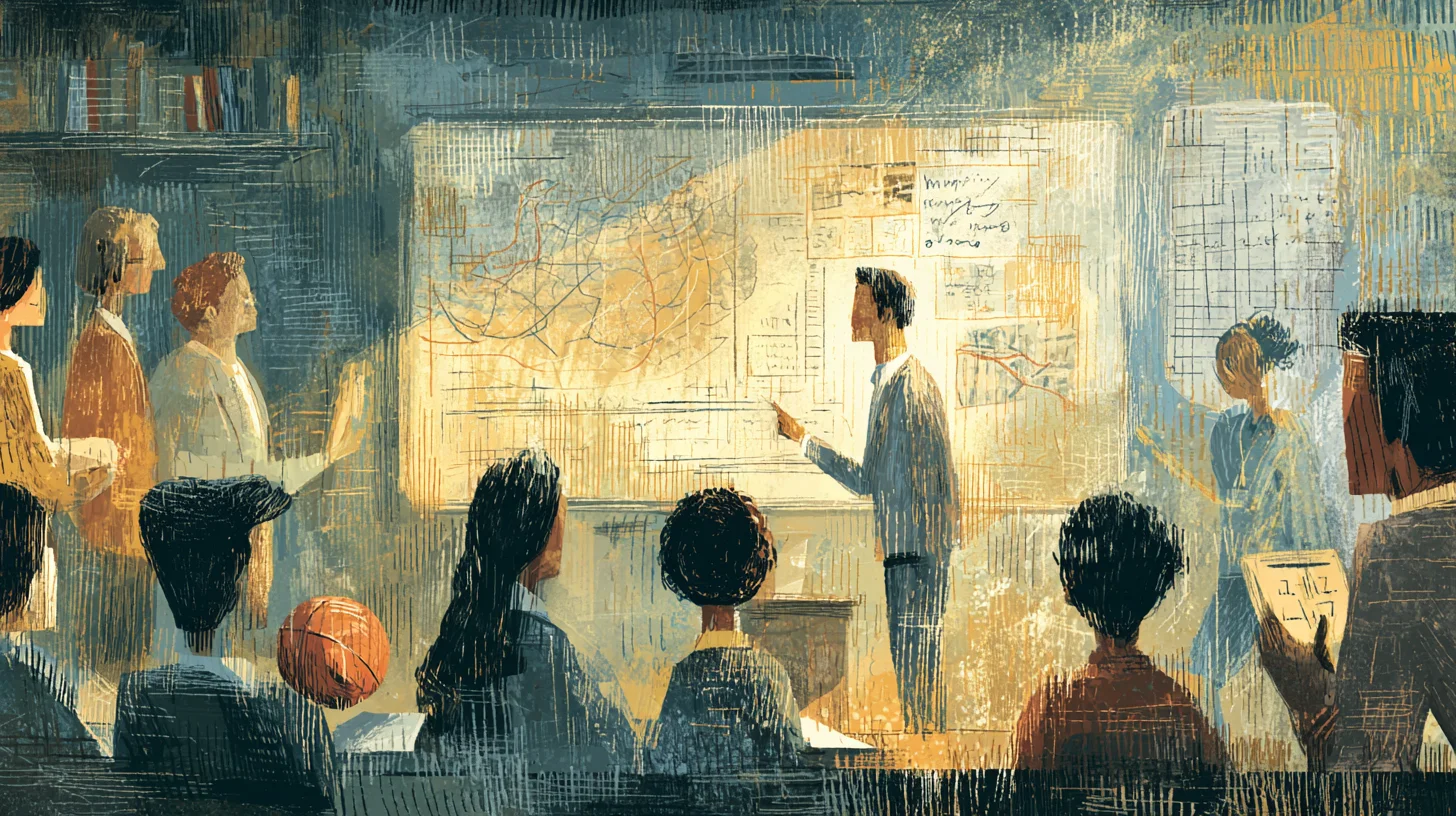
Meetings, one-on-ones, client calls, working sessions, stakeholder reviews, and the conversations that happen in hallways or after the meeting ends can look wasteful if you measure them only against production. But in an AI-accelerated environment, these interactions are part of the production system. This is where ambiguity gets reduced, resistance gets surfaced, risk gets interpreted, and commitment begins to form.
The problem is not that meetings exist. The problem is that many meetings are poorly designed, mismanaged, and underappreciated. They are treated as ritual rather than as decision mechanisms. They are used to share information rather than to make decisions. They are designed for the convenience of the person who called them rather than for the needs of the audience.
In the new work, the useful meeting is not a ritual. It is a forum to ask hard questions. What are we deciding? What are the real objections? Who owns the next step? What happens now? What can we do with the team, the information we have, and the time left to get to the next step?
AI can generate options. It can help make the case. But it still does not replace the person who knows which stakeholders matter, who is nervous, who is skeptical, who quietly shapes outcomes, and what kind of argument will move a given audience from caution to commitment.
Social Skill Is No Longer Secondary
For years, many organizations treated social skill as the softer layer sitting on top of the “real” work. That story is getting harder to tell with a straight face.
When technical output becomes cheap, relationships become more valuable.
The ability to read a room, handle friction, reassure a worried client, translate across functions, and build trust over time is not just a pleasant complement to execution. In many environments, it is one of the main ways value gets realized. The person who can produce a competent first draft is becoming common. The person who can get four skeptical groups to agree on what happens next is not.
This does not mean charisma becomes the new core skill. The future does not belong to polished talkers floating above the work. It belongs to people who combine technical fluency with interpersonal range. The strongest professionals will understand the work well enough to use AI effectively and understand people well enough to get that work adopted, funded, and sustained.
The New Work, Step by Step
So what is the new work after AI acceleration?
It is the set of actions required to convert abundant output into coordinated action.
It starts with framing. Before the first prompt is written, the real problem has to be understood and the decision has to be defined: the audience, the constraints, the risks, and the standard for success. AI is powerful, but it becomes much more useful when it is pointed at a well-formed problem.
Then comes generation. This is where AI does what it does best: producing options, drafts, scenarios, summaries, prototypes, and analyses with remarkable speed.
But generation is only the opening move.
Next comes distillation. Raw abundance is not value. Someone still has to reduce a large volume of output into a clear recommendation: here are the options, here are the tradeoffs, here is the risk, here is what I recommend, and here is the decision we need to make.
After that, the work becomes unmistakably human.
Alignment means identifying who must agree, who can block, who will implement, and who needs reassurance before they will move. Persuasion means shaping the message for different audiences: the executive sponsor who wants strategic clarity, the finance partner who wants discipline, the operator who wants feasibility, the customer who wants confidence. Reassurance matters because many business decisions carry an emotional charge even when everyone pretends they are purely rational. People do not just want a smart plan. They want to know the plan is understood, owned, and safe enough to act on.
Then comes closure, the moment when discussion hardens into commitment. Ownership gets assigned. Timing gets set. Action begins. Results get measured.
And then comes learning. The most effective professionals will not just improve their prompts, tools, and agents. They will improve their judgment. They will improve their interpersonal skill. They will look back at where AI helped, where it misled, where human concerns surfaced, and how the next cycle can run better.
A Practical Operating Model
To make this memorable, the operating model looks like this:
Frame -> Generate -> Distill -> Align -> Persuade -> Reassure -> Close -> Learn
Frame the problem before asking for output. Generate quickly with AI. Distill the output into a decision-ready recommendation. Align the stakeholders around what matters. Persuade each audience in language it can accept. Reassure people where risk feels personal or political. Close by assigning ownership and next steps. Learn by improving both your AI use and your human read of the system.
This matters because AI acceleration can create a dangerous illusion: that faster production automatically produces faster progress. Often it produces more options, more information, and more pressure. Without stronger judgment and coordination, speed at the front end simply moves the pileup downstream.
The organizations that benefit most will be the ones that pair machine efficiency with human clarity and spend real time on the hard things machines cannot do well: framing the problem, steering the output, separating signal from noise, and helping people move toward a decision.
What This Means for Careers
For individuals, the implication is plain.
Do not define your future value only by how well you produce first drafts. Define it by how well you move work through an organization.
Become the person who can use AI to compress execution time and then reinvest the time saved into decision quality, stakeholder trust, and implementation momentum. Learn to write the brief before you write the prompt. Learn to present options instead of dropping raw output on the table. Learn how decisions actually get made where you are. Learn who needs data, who needs reassurance, who needs involvement, and who needs time.
Relationship capital is no longer peripheral to performance. It is part of performance.
Spend time with customers. Understand adjacent teams. Learn why legal hesitates, why finance pushes back, why operations resists, and why executives stall. These are not distractions from the work anymore. They are the terrain on which the work actually gets done.
What This Means for Organizations
For leaders, the challenge is to stop measuring value with yesterday’s proxies.
If AI reduces the time required to produce analysis, draft content, or code, then output volume becomes a weaker signal of contribution. Organizations will need to reward problem framing, prioritization, decision quality, cross-functional influence, and successful adoption.
Hiring should move toward people who combine technical fluency with judgment and communication. Management systems should reduce empty status reporting and increase clarity around ownership, tradeoffs, and decisions. Teams should be designed not only to generate work faster, but to convert it into action with less friction.
The biggest mistake is to treat AI as a simple labor-reduction tool while ignoring the human conversion layer. Some firms will indeed need fewer hours for pure production tasks. But many will also need stronger capabilities in implementation, internal consulting, customer success, change management, and leadership communication.
The winners will not be the organizations that produce the most output. They will be the ones that turn output into decisions and decisions into results.
The Future of Work Is Not Less Human
The new work after AI acceleration is not a sentimental defense of soft skills, and it is not a denial that automation is real. It is a recognition that when machines make production cheaper, the scarce work that remains carries a distinctly human weight.
Judgment rises in value. Trust rises in value. Interpretation, coordination, and accountability rise with them.
The central question is no longer only, “Can AI produce this?” In many cases, it can.
The better question is, “Who can turn that output into a decision, a relationship, a commitment, and a result?”
The village never stopped needing the mill. The faster wheel was a gift. But once flour became abundant, the work that mattered most moved somewhere else. It moved into judgment. Into trust. Into coordination. Into the quiet human labor of turning raw plenty into bread on tables before nightfall.
That is the new work after AI acceleration.
And the people who learn to do it well will not be displaced by AI so much as amplified by it.