 Ted Tschopp
Over the last couple of months, I have been reading through the Model Context Protocol specification and following public statements from Anthropic developers about where MCP is headed next. What follows is my synthesis of those materials: not a prediction about every possible future direction, but a factual look at the roadmap items that appear to be shaping the next phase of the protocol. The focus is on the concrete changes now coming into view: transport scalability, server discovery, long-running tasks, enterprise authentication, event-driven triggers, streaming results, skills, extensions, SDK improvements, and better client-side patterns for using MCP in production.
The Model Context Protocol is entering a new phase. After a year of rapid ecosystem growth, MCP’s roadmap is shifting from proving that a common agent-integration standard is needed to making that standard reliable enough for production-scale agentic systems. The current MCP specification defines an open protocol for connecting LLM applications with external data sources and tools, using a host-client-server architecture and primitives such as tools, resources, prompts, sampling, roots, and elicitation.
That shift matters because 2026 agent deployments are expected to look different from the coding-agent-heavy experiments of 2025. Coding agents are unusually favorable environments: they often run locally, can call compilers, operate in sandboxes, and have a technical user nearby to inspect or correct results. General knowledge-work agents need a broader integration layer. They must connect to SaaS systems, internal systems of record, shared drives, data warehouses, ticketing systems, communications platforms, and identity infrastructure. MCP’s 2026 roadmap is therefore centered on connectivity, scalability, enterprise readiness, and richer agent-to-system interaction.
MCP has already moved well beyond its initial local-only shape. Early reference servers focused on basic data and development integrations such as databases, filesystems, Git, search, and fetch. The ecosystem then expanded into SaaS integrations and internal enterprise servers connecting agents to systems such as CRM, Jira, internal wikis, Snowflake, HR systems, Slack, and knowledge bases. MCP is now being used not only in visible public integrations, but also behind corporate firewalls where organizations are connecting AI systems to real business data.
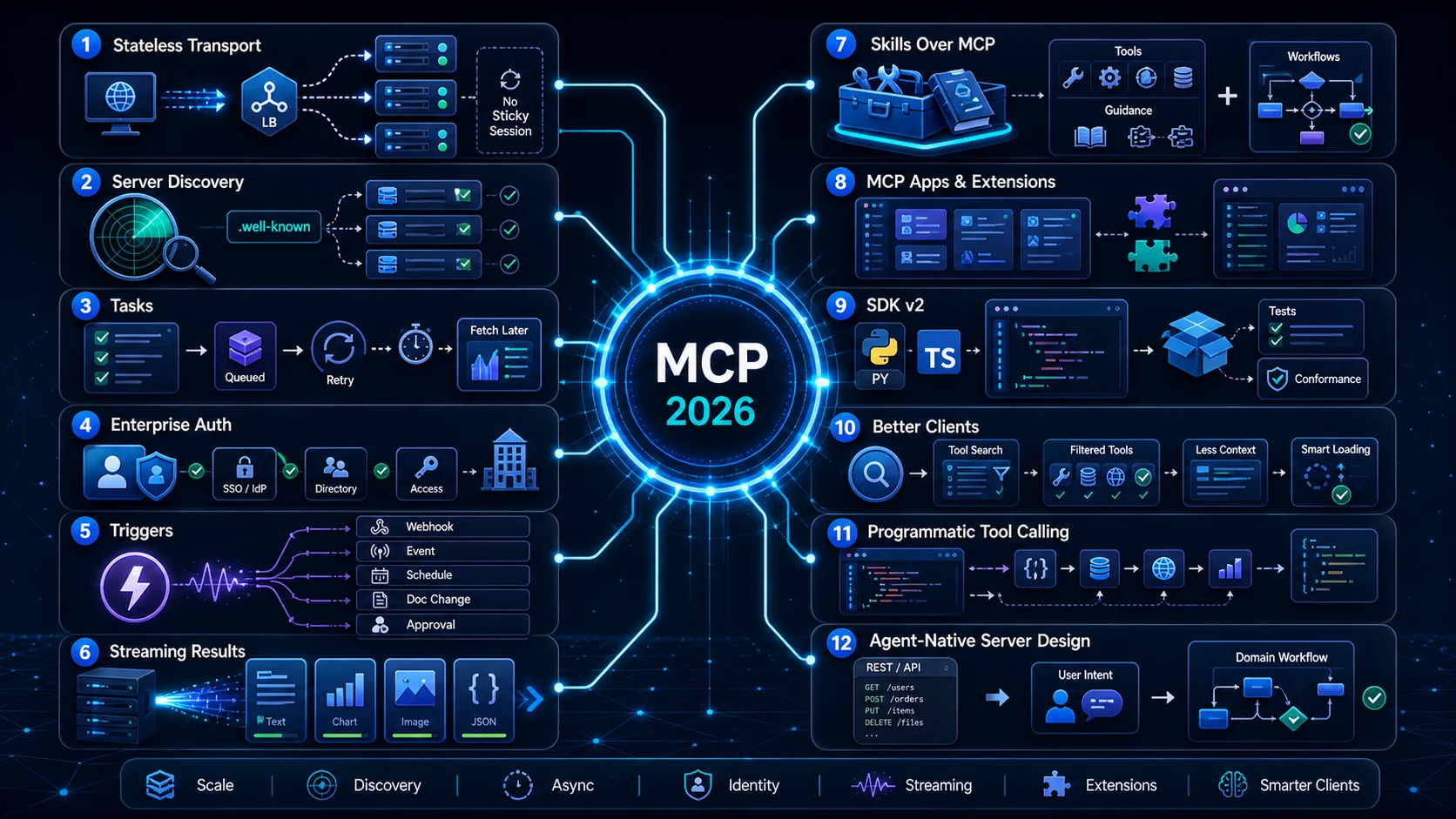
1. Stateless Transport for Hyperscale MCP Deployments
A major near-term roadmap item is transport evolution. The current Streamable HTTP transport works for many use cases, but it creates scaling challenges for large deployments because MCP connections can require stateful session handling. That makes it harder to run MCP servers behind load balancers, proxies, serverless platforms, Kubernetes, and other horizontally scaled infrastructure.
The next transport direction is to preserve the full MCP specification while allowing MCP servers to behave more like stateless web services. The goal is to make MCP easier to deploy across multiple server instances, easier to operate behind infrastructure middleware, and more resilient to server restarts or scale-out events. The official roadmap identifies stateless operation, scalable session handling, and behavior behind load balancers and proxies as core transport priorities.
This is expected to land in the June 2026 specification cycle, with SDK support following soon after. The practical outcome is that MCP should become easier for hyperscalers, enterprise platform teams, and SaaS providers to run at production scale without giving up important protocol capabilities.
2. Server Discovery Through Well-Known Metadata
Closely related to transport scalability is server discovery. MCP is moving toward a model where clients, agents, crawlers, browsers, and registries can discover MCP server capabilities through standardized metadata exposed at well-known URLs.
The official roadmap describes “MCP Server Cards” as a standard for exposing
structured server metadata through a .well-known URL, allowing external
systems to discover what a server can do without first opening a full MCP
connection.
This matters because MCP adoption is creating a discovery problem. As more organizations expose MCP servers, agents need a reliable way to determine whether a website, service, or enterprise endpoint has a relevant MCP interface. Server discovery moves MCP closer to web-scale integration: instead of requiring manually configured connections everywhere, agents can identify available MCP capabilities in a more standardized way.
3. Tasks for Long-Running and Agent-to-Agent Work
Another priority is improving the Tasks primitive. Tasks are designed for asynchronous work: a client can initiate work now and retrieve results later. This is increasingly important as models become capable of longer-running autonomous workflows and as agents begin to delegate work to other agents or remote systems.
Tasks are not just a convenience feature. They are a protocol-level answer to the problem of long-running agentic communication. A tool call may be appropriate for a quick lookup or short operation, but enterprise workflows often involve background work, retries, waiting for external systems, human review, or coordination across multiple services. Tasks provide a better abstraction for those cases.
The official roadmap says the Tasks primitive already created a “call-now / fetch-later” pattern, but production use has exposed gaps in lifecycle semantics. The next work focuses on retry behavior, result expiry, and operational issues discovered as more deployments run tasks at scale.
4. Cross-App Access and Enterprise-Managed Authentication
Enterprise readiness is one of the clearest themes in the MCP roadmap. MCP has already added authorization work, but production deployments still need smoother identity and access management.
One highlighted roadmap item is cross-app access. The goal is to let users authenticate through their organization’s existing identity provider and then use MCP servers without repeatedly going through separate OAuth flows. In practice, that means MCP integrations should be able to work with enterprise identity systems such as Google Workspace, Okta, and similar providers so that MCP access feels like part of the normal enterprise SSO environment.
The official roadmap also identifies broader enterprise needs: audit trails, observability, SSO-integrated flows, gateway and proxy patterns, authorization propagation, session semantics, and configuration portability across clients.
The direction is clear: MCP should become less visible to the average business user. Ideally, the user should not think about protocol setup, repeated login flows, or client-specific configuration. MCP should simply connect the agent to the authorized enterprise systems the user is already allowed to access.
5. Triggers: Webhooks for MCP
MCP is also moving toward event-driven behavior through triggers. Today, clients often learn about server-side changes through polling or open connections. Triggers would let MCP servers proactively notify clients when new data is available, when an interaction is needed, or when an event should cause an agent to re-engage with a server.
This is effectively a webhook-like model for MCP. It enables richer productivity workflows: an agent could be notified when a document changes, a ticket reaches a certain state, a workflow needs approval, or a business event requires follow-up. The official roadmap describes this as “Triggers and Event-Driven Updates,” where standardized callbacks could let servers notify clients with ordering guarantees across transports.
Triggers are especially important for enterprise agents because many business workflows are not initiated by a user typing a prompt. They are initiated by events in systems of record.
6. Native Streaming and Better Result Types
Another roadmap focus is native streaming. MCP currently returns tool results in ways that are not optimized for incremental output. That is limiting for interactive scenarios where results should appear progressively, such as generated text, audio, video frames, large analysis jobs, or long-running data operations.
The roadmap points toward streamed results and reference-based results. Streaming would allow clients to receive output incrementally. Reference-based results would let clients decide when to pull large payloads into context instead of automatically polluting the model context with bulky data.
This is a practical fix for two problems at once: latency and context management. Incremental results make tools feel more responsive, while references help prevent large outputs from being pushed into the model context before they are needed.
7. Skills Over MCP
Skills over MCP is one of the more important upcoming extensions. The idea is to let MCP servers bundle domain-specific instructions and operational knowledge alongside their tools. For large MCP servers with many tools, this helps the agent understand not only what tools exist, but how to use them correctly.
This is a different layer from tool definitions. Tool schemas describe callable capabilities. Skills explain domain procedures, best practices, workflows, and usage patterns. For example, a large finance, CRM, data warehouse, or developer-platform MCP server may expose many tools, but the agent also needs guidance about which tools to use together, what order to use them in, and what constraints apply.
Skills over MCP would let server authors update that domain knowledge centrally instead of depending on separate plugin registries or client-side prompt files. Some implementations can approximate this today with a “load skills” tool, but the roadmap points toward formal protocol semantics for serving skills over MCP.
8. MCP Apps and the Extension Mechanism
MCP is also expanding through extensions. MCP Apps show what becomes possible when an MCP server can deliver not just tools and data, but also interactive user interface patterns that a compatible client can render.
This is not intended to be universal across every kind of client. A web-based client can render HTML or rich UI, while a command-line client may not. That is why the extension mechanism matters: it allows MCP to support richer experiments without forcing every feature into the core protocol. MCP Apps and skills over MCP are examples of how extensions can let the ecosystem explore new interaction models while preserving compatibility in the core standard.
The broader roadmap also identifies the extensions ecosystem as an area to mature, including extension support in registries and continued development around authentication and apps.
9. SDK v2 for Python and TypeScript
The roadmap also includes a developer-experience push. Python SDK v2 and TypeScript SDK v2 are expected in the coming months, with a focus on better ergonomics for building MCP clients and servers.
This is important because protocol adoption depends heavily on SDK quality. As MCP moves from experimentation to production, SDKs need clearer shapes, better stability signals, and easier migration paths. The official roadmap also calls out conformance test suites, SDK tiers, and reference implementations as part of validation work around new features.
10. Better Clients: Progressive Discovery and Tool Search
Not every important MCP roadmap item is a protocol change. A major ecosystem focus is better client behavior, especially around context management.
One criticism of MCP is that it can create context bloat when clients naively dump every available tool into the model context. The proposed answer is progressive discovery: clients should not load all tools up front. Instead, they should use mechanisms such as tool search and load tools only when the model needs them.
This reframes context bloat as primarily a client-harness problem, not an unavoidable protocol problem. MCP moves information across the wire, but clients decide how to present that information to the model. Better clients should defer tool loading, search available capabilities, and reduce unnecessary context use.
11. Programmatic Tool Calling and Composability Through Code
Another client-side focus is programmatic tool calling, sometimes described as code mode. The idea is to avoid making the model orchestrate every tool call through repeated inference steps. Instead, the client can provide an interpreter or execution environment, let the model write a small script, and have that script call MCP tools programmatically.
Structured output is key to this pattern because it gives the model type information about tool return values. With structured outputs, the model can compose results, filter JSON, transform data, and call multiple tools through code without bouncing back to inference for every step. This can reduce latency, token usage, and orchestration overhead.
This also answers a common comparison with CLIs. Shell commands are composable because they can be piped and scripted. MCP can support a similar style of composition when clients expose a code execution environment and MCP tools provide structured outputs.
12. Agent-Native Server Design
The roadmap also implies a change in how MCP servers should be designed. A poor MCP server is just a one-to-one wrapper around a REST API. That approach may expose many endpoints, but it often produces a bad agent experience.
Agent-native MCP servers should be designed around workflows, user intent, and meaningful domain operations. They should use MCP’s richer semantics: structured outputs, resources, elicitation, tasks, skills, and MCP Apps where appropriate. Server authors should think less about copying API surfaces and more about how a human would want to accomplish a task through the system.
This is a critical production point. Enterprises do not need agents that can technically call hundreds of low-level endpoints. They need agents that can safely and efficiently complete business tasks.
The Larger Direction: A Connectivity Stack, Not a Single Tool
The MCP roadmap does not position MCP as the only connectivity mechanism agents will use. The emerging agent stack includes skills, MCP, CLIs, APIs, and computer use. Each has a different role.
Skills are useful for reusable domain knowledge. CLIs are powerful in local, sandboxed, developer-oriented environments, especially when the commands are already represented in model pretraining. Computer use is helpful when the only available interface is a graphical application. MCP is strongest when agents need rich semantics, platform independence, authorization, governance, resources, long-running tasks, enterprise policy support, and durable integration with systems of record.
The 2026 roadmap is therefore not just about adding features. It is about making MCP a production-grade connectivity layer for agents that operate inside real organizations. The near-term releases focus on stateless transport, better task semantics, enterprise identity, server discovery, triggers, streaming, skills, SDK improvements, progressive discovery, and composable tool execution.
Taken together, these changes point to a more mature MCP ecosystem: easier to deploy at scale, easier to govern, easier for agents to use efficiently, and better aligned with the way enterprise knowledge work actually happens.
- MCP definition and architecture: Official latest MCP specification (Model Context Protocol)
- Why MCP exists: Anthropic MCP launch post (Anthropic)
- 2026 priorities: Official MCP roadmap (Model Context Protocol)
- Stateless transport: Future of MCP Transports blog + roadmap (Model Context Protocol Blog)
- Server discovery: SEP-1649 + Server Card charter (GitHub)
- Tasks: SEP-1686 + roadmap (Model Context Protocol)
- Enterprise auth / cross-app access: Enterprise-Managed Authorization + roadmap (Model Context Protocol)
- Triggers and streaming: Roadmap “On the Horizon” (Model Context Protocol)
- Skills/extensions: Roadmap extensions section + Extensions Overview (Model Context Protocol)
- MCP Apps: MCP Apps docs + SEP-1865 (Model Context Protocol)
- SDK tiering / conformance: Roadmap validation section + 2025-11-25 changelog (Model Context Protocol)
- Progressive discovery: Anthropic tool context + OpenAI tool search docs (Claude)
- Programmatic tool calling: Anthropic programmatic tool calling docs (Claude)
- Governance / Linux Foundation: MCP blog, Anthropic, Linux Foundation announcements (Model Context Protocol Blog)