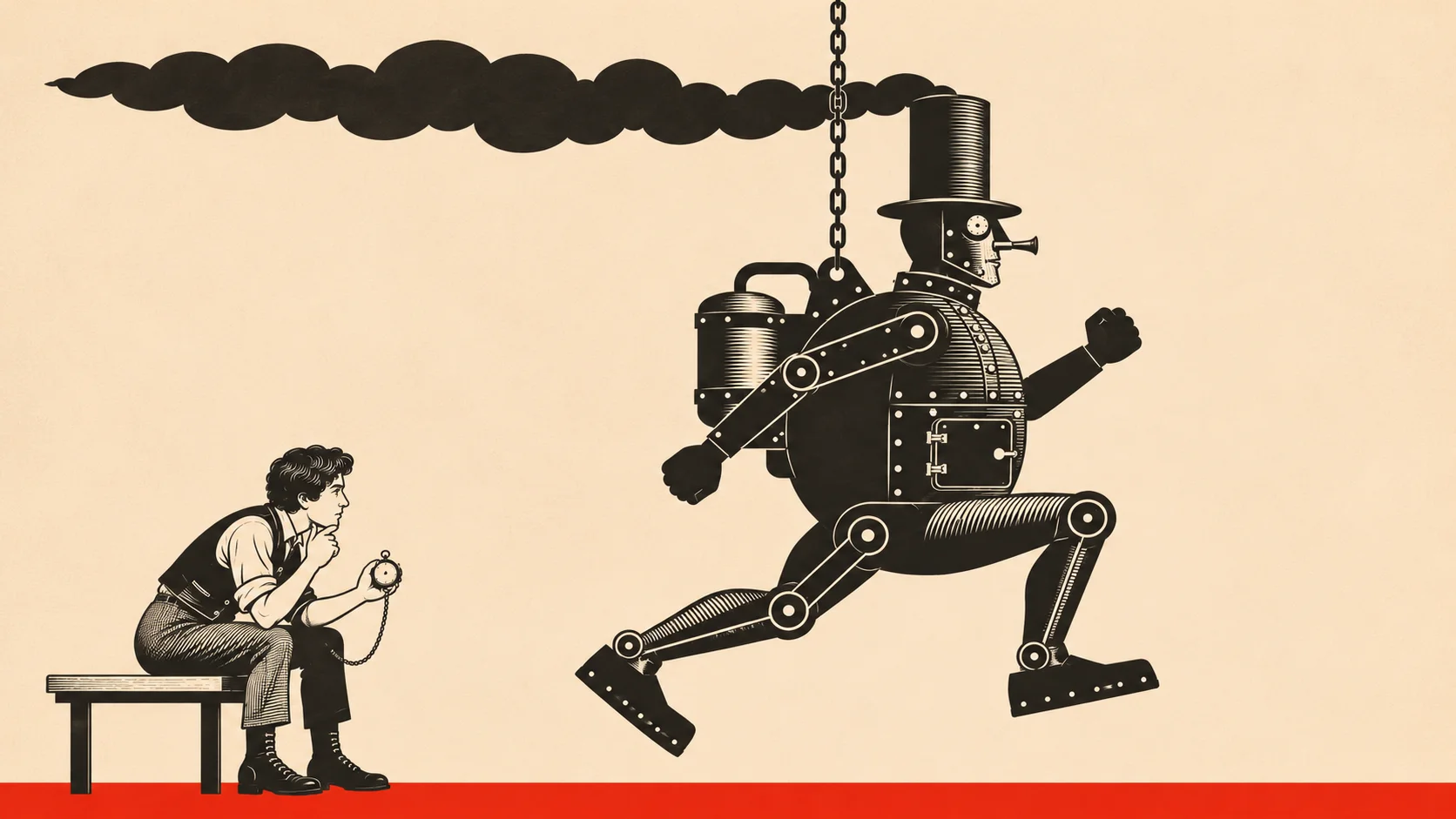

I grew up in a Lutheran family, so apocalyptic literature is familiar territory for me. During the reformation in Europe, there was a lot of focus on the end times. Most people couldn’t understand how the world was going going to look when their children grew up. They saw the discovery of the new world, they saw the rise of new empires, and they saw the spread of new ideas that challenged old certainties. In the end those who had hope saw a world transformed, full of possibilities and new beginnings. Those who despaired saw only ruin and loss all around them.
I am a firm believer that that human ingenuity and curiosity can drive progress, even in the face of seemingly insurmountable challenges. Science leads to engineering, which leads to the creation of products, which are then sold to people who use them to solve problems and improve their lives. That improvement in their lives allows them the freedom to dream. From that dreaming some produce art that challange us, and that art inspires more innovation and science. This is one of the most basic cycles of human progress.
We are again at the point where human ingenuity and curiosity are poised to drive transformative change. The challenges we face may seem insurmountable, but history has shown that our capacity to innovate and adapt can lead to remarkable progress.
So join me as we discuss some stories of human ingenuity, from the industrial revolution. These dreamers were trying to give people a vision of how technology could reshape the world and expand the boundaries of what was possible. They were all wrong, almost to the point of absurdity, but their imagination and ambition paved the way for future innovations.
As we read the news and the latest developments in AI, it is easy to forget that the same spirit of curiosity and ingenuity that drove the industrial revolution is alive and well today.
In order to tell this story, I went looking for an old story about somebody climbing inside a giant steam-powered man. I’ve read enough science fiction and fantasy that I had a pretty good idea where the driver ought to sit. Then I found Edward S. Ellis’s The Steam Man of the Prairies, published in 1868. Johnny’s first steam man walks through the workshop wall. To test its speed, he hangs it up with its feet clear of the floor. Nearly sixty miles an hour on rails, he figures. Thirty on an ordinary road. The hole in the wall convinces me it can walk. Johnny’s workshop
Keep Johnny in mind as we read about the news of the last couple of weeks. Watch a model operate a robot arm and I can furnish the whole house it’ll clean before I’ve given it a way up the stairs. We overthink and underthink the same future, sometimes in the same sentence. The robot arm
Playground’s robotics researchers published two answers to the question of when will Johnny’s dream be a reality. On their real robots, the leading AI model finishes about 1 in 10 of the hardest tasks. Now if you project their pace since September of 2026 forward a 12 months, they are projceted to be doing 9 out of the 10 tasks by September 2027. However they have been working on this now for two years. If you use that as the pace, they will only be getting 3 out of 10 on a good day. So which dream will come true? I don’t know. With both estimates on the page, I can see exactly which assumption I’d be betting on. Think of a hand that keeps dropping a bottle. Better software might fix the grip. If the fingers won’t fit around the bottle, progress could stall for months and then jump the day somebody changes the physical dimensions of that hand. Playground’s two forecasts
Now suppose the person who signs your paycheck uses the steeper and more agressive line to set next year’s HR budget. That forecast can change your life as soon as those numbers are locked in, but months before reality tells you which future you have. We can all enjoy the demonstration and have a perfectly good reason to worry about Monday morning, even if we are hopeful for the future world our children will live in.
Depending on what you’re waiting for, the worrying possibility might be that change comes too slowly. At Anthropic’s Nasdaq debut, Dario Amodei spoke about his father, who died a few years before his disease became curable. Amodei thinks people working with sufficiently powerful AI could fit a century of scientific and medical progress into a decade. Amodei’s remarks · The opening bell
I can understand wanting those years back. My father died on Halloween last year.
Find the volunteers for a clinical trial sooner and a one-year follow-up can start sooner. The patient still has to live the year. Even when a treatment works, somebody has to make enough of the medicine and get it to the person who needs it. If it arrives in time, a father and son might have another year together.
Who gets the afternoon?
In Edgar Rice Burroughs’s At the Earth’s Core (1914), an iron “mole” gets more power from a cubic inch than any other engine get from a cubic foot. Let’s grant the author his engine. But where does the heat go? Burroughs handwaves ice 245 miles beneath the surface. In medicine, as Amodei points out, the experiments have to keep pace with the ideas. Faster recruitment can start a one-year follow-up sooner. The patient still has to live the year. Burroughs’s iron mole · Alternate edition
Google DeepMind’s Tim Genewein asks what happens if better hardware and software let us run the same AI job each year for about a quarter of what it cost the year before. Keep that up for ten years and a job that costs a billion dollars in computing today would cost about a thousand. Let’s grant him his thousand dollars. How much of the customer’s bill was the computing? Genewein’s calculation
Take a machine shop. Claude can look up what similar jobs cost and draft a quote from a customer’s request. Somebody still has to look at the drawing and decide whether the shop can hold the tolerances. Say it’s a routine bid and the software really does save half a day. The quote goes out before lunch. Anthropic’s factory-quote example
Do that often enough and customers may come to expect every quote by lunch. To keep that promise, the owner puts all the routine bids through the software. Those bids used to go to the apprentice. Five years later a strange drawing comes in. The senior machinist has retired and everybody turns to her. She’s never had a bad estimate go out under her name. She’s missed those Friday afternoons at the bench figuring out where the extra four hours went.
There’s another way the owner could spend that first afternoon. Pay the apprentice to price the job herself, lay her estimate beside Claude’s, and take the difference out to the bench with the senior machinist. Maybe he can show her why the second cut needs a different setup. Maybe she’s spotted a way to hold the part that neither he nor the software thought of. Now a faster quote buys her an education. Genewein’s price curve fits either shop.
The wool workers of Leeds had a question for the local merchants in 1786. Machines were taking over some of the work of preparing wool for spinning, and the workers had been told to learn another business. They wanted to know “who will maintain our families” during a second apprenticeship. What if another machine took the new trade by the time they’d learned it? These were people trying to choose something they could teach their children. They’d already done the arithmetic on how much wool a machine could work in a day. They wanted somebody to do the arithmetic on how a family was going to eat. The Leeds wool workers’ petition
What a horse does with its feet
Ten years after Ellis got his steam man’s feet off the workshop floor, Eadweard Muybridge photographed a mare named Sallie Gardner running on the track at Palo Alto. In one frame, all four hooves are off the ground, tucked under her belly. You can look at the photograph for as long as you like. Try getting a horse to hold that pose for a painter. Muybridge’s photographs of Sallie Gardner
Faster shutters made that picture possible. Muybridge’s photographs caught the attention of Thomas Eakins, a painter, and Fairman Rogers, an engineer and horseman. Their correspondence with Muybridge helped bring him to the University of Pennsylvania, where he had the room and the money to keep going. Two plates in Penn’s collection show a horse named Buckskin favoring its right front leg as it walks. A painter could study the bend of that leg. So could someone trying to understand a limp. Penn’s history of the motion studies · The plates of Buckskin
For Kevin Bond, an engineer at OpenAI, astronomy started with a camera pointed at the night sky. He used Codex to search years of measurements from the Kepler space telescope for stars that dimmed at regular intervals. A SETI Institute astronomer ran a separate search and found the same dips in the light from two stars. Whether orbiting planets caused those dips is still an open question. A fellow who liked taking pictures has given astronomers two places to look. Searching the Kepler observations
I can follow the science that went into building a better camera, and I can see how a photograph might send somebody back to science with a new question. But how could I have guessed from the specifications for the shutter what somebody would think worth photographing? You can take a picture for the pleasure of it. You can keep a picture of someone your grandchildren will never meet.
As an architect, I need to remember that when I make forecasts or set strategy. Some of the most inventive minds of the Industrial Revolution could tell you where every connecting rod went. They still couldn’t tell you everything people would do with a camera.
If we’re going to admit how little we know about the future, I think we owe ourselves the hopeful half of that admission. The person predicting the end of useful human work knows as little as I do about what that apprentice might invent. I’d like to find out. She needs to be paid while she learns, so I’d leave the afternoon in the budget.
That brings me back to the apocalyptic literature I grew up with in a Lutheran family. Those stories are honest about the hardships of a world coming apart, and they still hold out hope for the people who have to live through it. I think of Sam and Frodo in The Lord of the Rings. Neither knows how the journey will end. Even with orcs about, Sam can see when Frodo needs a hand. That’s what the best stories do for me. They take me into the difiicult parts and let me see what’s still worth doing there.
As we move from the industrial age into an age of intelligence, we can’t see around the corner yet. When I read the day’s AI news and think about the decisions I have to make, I come back to something those old stories taught me. Our job is to have the courage to get up the next morning and look after one another. Sometimes that means leaving someone an afternoon at the bench or an evening free to point a camera at the sky. One day, somebody looking through those pictures might find another planet in this lonely universe. Looking for dips in starlight


Comments
Join the discussion on Mastodon using your Fediverse account. Public replies known to the publishing server appear here.
Loading the discussion…